
The robust research laboratory in the outskirts of France is the last place you would expect an invisible murderer to be lurking; the cloudless sky and rolling hills are a paradoxical setting for a mysterious killing to begin. Nonetheless, an unassuming lab technician would eventually fall prey to one of the most mystifying deaths the scientific world has ever seen.
The year is 2010, and Emilie dresses for work at the laboratory. As a biomedical researcher, she examines unknown or rare diseases to develop treatments. Currently Emilie is studying “Bovine Spongiform Encephalopathy”, a rare disease commonly seen in cows. This pathogen sneaks into the animal, making its way up the spine to the most vital part of the body: the brain. An agent of espionage, the immune system is ignorant to its schemes…until it is too late. Gradually it devours the cow’s brain tissue, causing intense burning sensations in the head. Eventually, psychotic behavior ensues as a result of degeneration of the brain. Cows will attack others and make spastic movements, keying the name “Mad Cow Disease.” The scientist is studying the disease in mice, attempting to determine whether the virus is composed of a specific protein called prions. Prions are radical revolutionaries, manipulating healthy brain cells to assault other cells until chaos ensues and the entire system is destroyed.
“Bon jour!” she exclaims as she passes a fellow researcher in the building. Striding down the long, grey hallways, she makes her way to the room labeled, “BSE Mice Study.” Lights flicker and pitched squeaks of the mice echo against the hollow walls. Like a surgeon, she thoroughly washes her hands and squeezes two pairs of latex gloves on each. Working with viruses is risky, particularly when there is little known about how it enters the body and what kinds of organisms it harms. You can never be too careful.
Injecting a syringe into the container with infected brain tissue samples, Emilie turned toward the microscope too quickly. The syringe needle pierced through her double gloves, causing the slightest amount of bleeding. To the average person, a minuscule prick was nothing to be concerned about, but Emilie knew better, for even the slightest break of the skin can invite thousands of microscopic prions into the bloodstream.
“Crap!” Emilie bolted down the hall to the nurse’s lounge. The elderly nurse looked up from her computer, frightened by Emilie’s panicked breathing.
“I…I cut myself. I’m working with a viral disease, you need to make sure I’m not infected. Do you have any saline solution?”
“Why of course I do, dear. No need to worry, this happens more than you would think and everyone turns out fine. No need to be huffing about!”
Many lab technicians make errors and nothing comes of it, sure. This, of course, is not that story.
After getting cleaned up, Emilie decided to leave for the day. The nurse said the scare at the lab was probably nothing, but she wanted to be sure that there were no side effects before returning. And for seven long years, there were none. Not until November 2017, when Emilie awoke to burning in her right neck and shoulder. Six months later, her symptoms mimicked that of a stroke: the entire right side of her body was in agonizing pain. Gradually, these physical ailments developed into mental sufferings. Depression gave way to vivid hallucinations, and within two years Emilie became a new, deranged person. She would experience mood swings, psychotic behavior, memory loss, and difficulty walking. Doctors wrote it off as mental illness, severe anxiety and major depressive disorder, but that could not explain the physical illnesses or memory loss. Her MRI’s were clear. What evil forces were killing Emilie from the inside out?
Finally, doctors diagnosed Emilie with Creutzfeldt-Jakob disease (vCJD), the mutated version of Mad Cow Disease that is found in humans. In June of 2019, nine years after the fatal stabbing in the lab, Emilie passed away.
The most puzzling faucet of this case is how long it took Emilie to contract symptoms and die. Although the vCJD is incredibly rare, almost all of the other cases have a much faster rate of fatality. One explanation could be that other victims contracted the disease through ingestion; that is, they consumed beef from infected cattle. In these situations the rate of degeneration is much faster than if the virus was injected into the bloodstream, like with Emilie.
Research into this human mutation of Mad Cow Disease has revealed shocking findings. A recent study links up to 13% of all Alzheimer’s victims as actually having Creutzfeldt-Jakob disease. This was discovered because both diseases involve the infamous prion protein, and this finding has potential to lead to more effective treatments for Alzheimer’s patients. Another unrelated study, which shows that meat eaters have three times the risk of developing dementia as opposed to vegetarians, confirms this. Since vCJD is not contagious, the primary way of contracting it is by eating contaminated beef. Although there is no cure, scientists are developing new methods of diagnosing it, such as blood tests and MRIs.
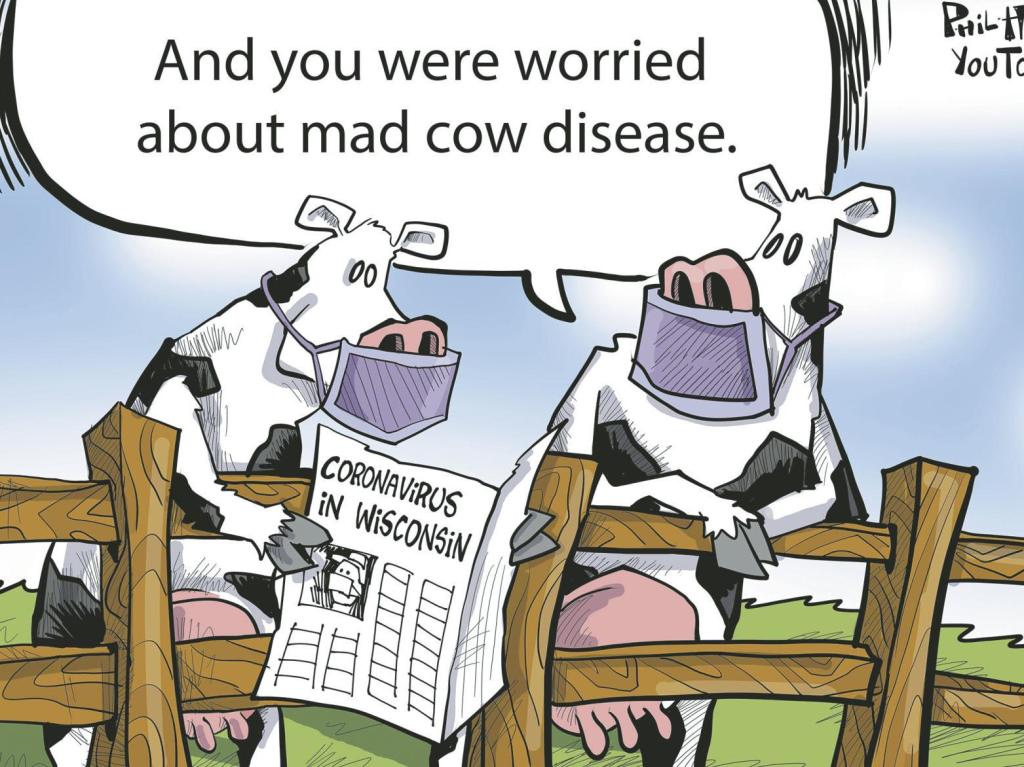
In this vast world filled with countless villains attacking our noble immune systems, we must remain vigilant. COVID-19 is surely not the only pathogen out there eager to destroy, and often they lurk in the most unassuming places.
And just remember, it’s usually the silent ones that are the most deadly.
Works Cited
L;, Broxmeyer. “Thinking the Unthinkable: Alzheimer’s, Creutzfeldt-Jakob and Mad Cow Disease: The Age-Related Reemergence of Virulent, Foodborne, Bovine Tuberculosis or Losing Your Mind for the Sake of a Shake or Burger.” Medical Hypotheses, U.S. National Library of Medicine, https://pubmed.ncbi.nlm.nih.gov/15694685/.
“Mad Cow Disease.” Mad Cow Disease | Michigan Medicine, https://www.uofmhealth.org/health-library/tu6533.
Medicine, Center for Veterinary. “All about Bse (Mad Cow Disease).” U.S. Food and Drug Administration, FDA, https://www.fda.gov/animal-veterinary/animal-health-literacy/all-about-bse-mad-cow-disease.
Moore, Mary, and Reviewed By Gilmore Health | On: July 15. “Creutzfeldt-Jakob Disease: A Lab Technician Gets Disease 7 Years after Accidental Cut.” Gilmore Health News, 15 July 2020, https://www.gilmorehealth.com/creutzfeldt-jakob-disease-a-lab-technician-gets-disease-7-years-after-accidental-cut/.
Rettner, Rachael. “Lab Tech Develops Fatal Brain Condition after Accident with ‘Mad Cow Disease’ Samples.” LiveScience, Purch, 2 July 2020, https://www.livescience.com/mad-cow-disease-lab-accident-vCJD.html.
Staff, Familydoctor.org Editorial, and Alex Rice. “Mad Cow Disease – Brain Disease – Dementia.” Familydoctor.org, 22 Jan. 2021, https://familydoctor.org/condition/mad-cow-disease/.
 Drops of Jupiter
Leave a comment