I just watched Christopher Nolan’s Inception for the first time, and if you haven’t seen the film, it is all about dreams. Leonardo DiCaprio’s character is troubled with memories of an alternate reality he and his wife created through their shared dreams, a world that is nearly indistinguishable from actual reality. Unlike the common dream experience, they are able to remember their dreams as if they had parallel lives and time had paused on the other end. The only way I can articulate what it feels like to come back to this reality, my life in San Diego, is that the Netherlands was my lucid “dream state” like in Inception. It feels like time stopped here and I clicked “resume” while pausing my dual life in Utrecht. Inception is seemingly impossible because one must plant an idea in another’s mind through entering their dream-state subconscious. I fear someone (God) planted lessons in my “dream-like” multiverse, Utrecht. I learned so much in my alternate reality, more than I expected to and in ways I wasn’t anticipating.
Cultural differences I’ve noticed. (note: I know I am generalizing “Europe,” but comparing 17 countries within the continent would be too laborious so please forgive me)
#1.) Health is wealth, and Europeans value healthy food better. I only got mildly sick ONCE while abroad, despite traveling, being in hostels, and airports all the time. I attribute this to the healthier food standards in the EU, and now I am more conscientious about avoiding certain American preservatives.
#2.) “Stop and smell the roses” mentality. When I went to the Dublin NYC portal, I saw a perfect comparison of the US hustle culture compared to European’s “stop and smell the roses” mentality. Almost no one stopped on the NYC side of the portal, but Irish people brought signs with large crowds to wave to their Trans-Atlantic pals. I truly learned the art and value of romanticizing life, and I wish more Americans would value this over being “busy” and “climbing the corporate ladder.”
#3.) Culture bonds and shapes personalities. I don’t care what your personality is, if I met another American while abroad, we were instant friends. Similarly, my French, Irish, and Spanish friends (shoutout to the Irish international students, they somehow all knew each other) would click immediately with people of their culture. It is interesting to see how much culture influence’s one’s personality.
Things I have learned about myself.
#1.) You can learn a lot more by being alone. Although I made many wonderful friends abroad, there were more stretches of loneliness than I have ever experienced before. It was emotionally difficult in the beginning, but I grew in curiosity, self-reflection, confidence, faith, and my relationship with God by being alone. I called this my “introvert era” which is so ironic because I actually met so many new people, but I appreciated “me-time” more than I had before. Strangely, loneliness taught me how to be a more intentional and selfless friend.
#2.) Solo traveling is not as scary as it seems. As a woman, I was apprehensive about the idea of solo traveling to foreign countries. However, in most of Europe (with the exception of Vienna & Paris), I felt much safer than I do in the US. Solo traveling even ignited my self-confidence because I was able to take care of myself in new and foreign situations. My #1 tip for girls is to go to well-rated hostels with female-only dorms so you can make friends to travel with and use Google Maps everywhere!
#3.) Curiosity is the best emotion and life-learning is more meaningful than academic-learning. Seeing so many new places, art, and museums helped bolster my curious-mindset. I was determined to fully experience each and every city I visited, and to do that I needed to ask “why” to EVERYTHING. Why did Michaelangelo make David’s hands disproportionately large? Why do they eat a later lunch in Spain? Why is there no word for “you’re welcome” in Icelandic? This led to more discovery, and I have since recognized the full magnitude of the gift of learning.
#4.) Don’t let nostalgia hold you back. For the last few months in Utrecht, every memory I created was clouded under the tugging pain of believing that I will not enjoy my future life because I will be missing the memories I created here too much. Once I came back to San Diego, I did miss Europe. But the overwhelming rush of reverse culture shock I dreaded did not really happen. I fell into a new poetic joy of life, this time in a new, beachy color. As I type this, about to graduate from UCSD, I have comfort knowing that no one can take these memories away from me, and I myself will not be crippled under the longing to be back in them because I will be too busy enjoying the new life I will be in in the future.
Utrecht, NL-specific
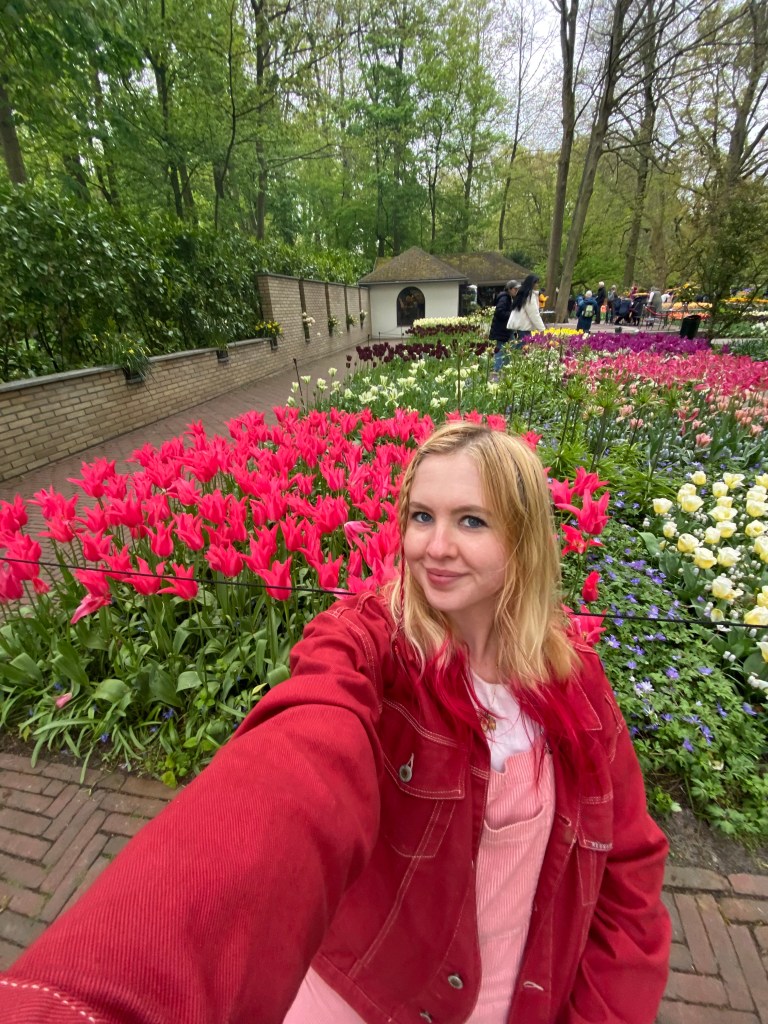
#1.) Winter demonstrates the value of the sun. Being from California, the Dutch winter was my first true winter experience: constant grey skies, bitter cold temperatures, and biking in the rain/wind. Although brutal, once the sun finally arrived and tulips bloomed, I recognized visible changes in my mood. The sun, which seems like a ‘right’ in California, is actually a ‘privilege’ to be appreciated.
#2.) Your value is NOT a metric. Dutch students are so different from American students, who stress about GPA and internships. In fact, Dutch schools don’t have any type of GPA, and my peers’ goal was simply to pass their classes. I found that this led to more intentionally curious, well-balanced students. In the US, every person is treated like a product that should be “marketed” and which can be metrically valued. For instance, if you have a lucrative job and make a lot of money you are highly valued, EVEN IF you lack love or purpose. A story that perfectly illustrates this is this: “An Italian is asked, ‘What do you do?’ and they answer, ‘I love to cook and go swimming with my family.’ When an American is asked, ‘What do you do?’ they answer, ‘I am a real estate agent’ or ‘I am an engineer.’ ”
#3.) Everyone is an ambassador. For many people, I was the only American they got to know, so it was important for me that I upheld myself with curiosity for others’ cultures, kindness, and respect. My friend, Andi, is one of my few Spanish friends, and because of her I view all Spanish people as super warm and energetic. After staying with my French friend and her family, I see French people as extremely hospitable. Once you leave your home country, you are an inherent ambassador and how you interact with others matters. Similarly, I was the only Christian many of my friends knew, so it was important for me to represent my faith well.
Final Note:
This is a living list. As I continue editing old vlogs from the year and reading back through my journal, I will likely add more lessons I have learned (as it seems to be infinite, which is something I am so grateful for). Read back if you want to see my additions!

 Drops of Jupiter
Leave a comment