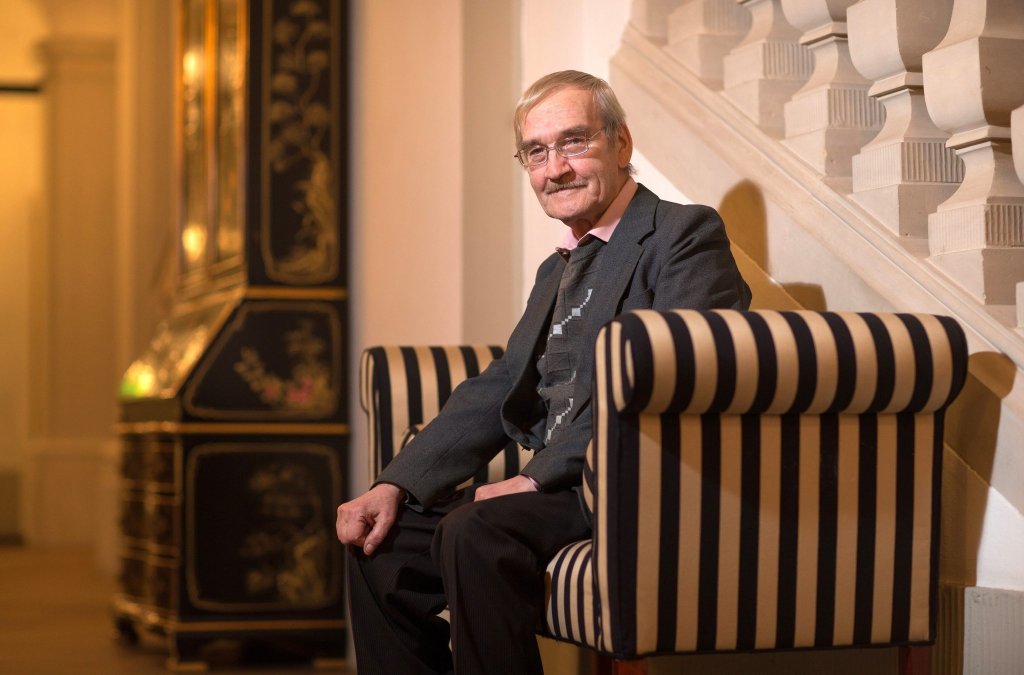
Good morning, Mr. Petrov. You have been dubbed a “Real Life Superhero” because of your noble and quick thinking that practically saved the world. Could you take us back to that fateful day of September 26, 1983? Did you suspect a nuclear holocaust was on the brink?
Not that on particular day, no. Of course no one would wake up, walk to work, and suspect that the globe could be quickly uninhabitable within the span of a few hours. The warning signs were there, though, and not just in the bright computer warnings. 1983 was the most tense parts of the Cold War, it seemed as if everyone was walking on eggshells. Ronald Reagan initiated a plan to deploy missiles to Germany and the UK, and threatened to shoot down any missiles before they reached the United States. He patronizingly dubbed this “Star Wars.” Everyone in Russia had the right to feel apprehensive, it was all anyone ever talked about. Children in classrooms were being taught emergency nuclear bomb drills, and hushed news was being widely spread in the country. The Soviet Union was the only nation that could compete with their nuclear weapon development, so that initiative was a direct threat to us. It would not have been a shock if the political forces of the United States chose to bomb Russia.
Walk us through your shift in Moscow, which would later be seen as the moment the world dodged catastrophe, thanks to you. Did you recognize that the fate of the world was in your hands?
In some ways, yes. Everyone within our department knew the gravity that a nuclear holocaust would have on the world, but on a larger sense, we did not. Knowing that one decision could dictate the fate of billions is not within the human capacity to understand, much less within five minutes.
Would you be able to walk us through that night? What was the atmosphere like?
Moscow is always frigid in autumn, but particularly at midnight. I vaguely recall it being pitch black outside, so dark that you could hardly see your fingers. I gradually drove to the secret bunker where the lieutenants were assigned and got to work.
What was your job, exactly?
I was a lieutenant colonel of the Soviet Air Defense Forces; I operated a device that detected airborne threats and made decisions on how to proceed in the interest of national security.
When did you notice something amiss that night?
Within the first hour of my shift, something I have never encountered before happened. Suddenly the eery silence of the bunker was interrupted with ear-pitching wails. The early warning system began flashing “LAUNCH” in bright red letters, and glaring alarms screamed throughout the room. The monitor detected five missiles originating from the United States were launched and heading toward Moscow. It felt like we were in the Apollo 13 spacecraft: frozen with fear.
How did you decide whether to respond or not?
The flashing warning signs were clear, and the detectors were rarely incorrect. Given the escalated tension within Russia and America, a direct attack would not have been strange. But I had a funny feeling in my gut. I knew that the US would send a force greater than five missiles. Five missiles, although powerful enough to obliterate entire cities, was not strong enough for an initial attack. I rationalized that these were false alarms, and decided not to report it.
How long did it take for you to reach this decision?
Five minutes. If we decided it was a nuclear attack we would have launched our own missiles, there would be no time to double check that the computers were correct or to negotiate with the US. We needed it act quickly, and so I did.
Five minutes, that is an awfully narrow time frame. What would have happened if you decided that the warnings were true?
Like I mentioned, we would have had to respond with nuclear force, and a full nuclear war would be underway. These weapons would have killed anywhere from 35 to 77 percent of Americans, and their counter-attack would ultimately kill 20 to 40 percent of Russians. Combined, this would have been 138 to 288 million people. I later learned, after speaking with physisists who study the effects of nuclear power, that an estimated 2 billion MORE would die of starvation and natural disasters as a result of the bombing. Thank goodness the alarms were mistakingly detecting sunlight off the clouds as missiles.
Your decision inadvertently rescued nearly 3 billion people’s lives. Could you explain what would have happened to these people, had you responded to the alarms?
Nuclear bombing is a horrific way to die, as it impacts people hundreds of miles from the initial bombing location. Within 10 seconds of it striking the ground, the explosion reaches its peak force, sending shock waves many miles away. Like a large-scale earthquake, buildings collapse and structures break, causing immense damage. In its initial vicinity, it is as if a section of hell broke through the ground. Giant fireballs vaporize everything surrounding it, and the carbon monoxide poisoning reaches anyone, even those hiding in underground bunkers. Within days, months, or even years, victims farther away would die from radiation poisoning. It is a real-life apocalypse.
You mentioned that 2 billion people would have perished from starvation as a result of the weapon. How does this occur?
The chemicals released from the bomb would cool the atmosphere around the world, which in turn would affect crops and livestock, resulting in worldwide famine.
That is unimaginable, and thanks to you, didn’t happen. How did others respond when they recognized that you saved the world from a devastating nuclear holocaust?
Initially, I was aggressively interrogated by my Soviet superiors at the base. They suspected that it was an act of treason, and believed that I should have responded to the alarm. I was inadvertently forced to retire early, even, having no honor to my name or recognition for what I have done for humanity.
You’re saying that you saved billions of lives from a horrific death, but were punished for this afterward?
Essentially, yes. Later I was recognized by the UN and other organizations, but Russian political leaders never apologized for viciously accusing me of treason.
We are so grateful to have the opportunity to speak with you, Stanislav Petrov. I am not sure a simple “thank you” is enough to express our gratitude for saving humanity. We will ensure that future generations know your legacy and honor your brave actions that dark September night.
Thank you very much for having me.
Works Cited
Chan, Sewell. “Stanislav Petrov, Soviet Officer Who Helped Avert Nuclear War, Is Dead at 77.” The New York Times, The New York Times, 18 Sept. 2017, https://www.nytimes.com/2017/09/18/world/europe/stanislav-petrov-nuclear-war-dead.html.
Hoffman, David. “‘I Had a Funny Feeling in My Gut.’” The Washington Post, WP Company, 10 Feb. 1999, https://www.washingtonpost.com/wp-srv/inatl/longterm/coldwar/shatter021099b.htm.
“Immediate Effects.” ICAN, https://www.icanw.org/catastrophic_harm_immediate_effects.
Matthews, Dylan. “36 Years Ago Today, One Man Saved Us from World-Ending Nuclear War.” Vox, Vox, 26 Sept. 2018, https://www.vox.com/2018/9/26/17905796/nuclear-war-1983-stanislav-petrov-soviet-union.
“Stanislav Petrov (U.S. National Park Service).” National Parks Service, U.S. Department of the Interior, https://www.nps.gov/people/stanislav_petrov.htm.
 Drops of Jupiter